


Cardinal & Ordinal Analysis, Types of Indifference Curves, Price Effect
- DR. Meenal Shah
- Dec 16, 2021
- 3 min read

• It analyses how a consumer chooses among different available goods and services given his income and prices of goods and services, in order to achieve the maximum satisfaction level, which is also termed as the consumer equilibrium point.
There are two approaches to determine and study consumer equilibrium
• Cardinal Approach:
✓ Given by Alfred Marshall in his book Principles of Economics (1890)
✓ Satisfaction can be measured in absolute numbers
✓ Standard measuring unit is utils
✓ The concept of Marginal Utility of money (MUm) was given by Daniel Bernoulli in 1738
• Ordinal Approach:
✓ Originally introduced by Pareto in 1906
✓ Satisfaction cannot be measured in absolute numbers, indeed can be ranked in order of preferences
✓ Indifference Curve Analysis (initially developed by Francis Ysidro Edgeworth in 1881). Later on Pareto was the first one to actually draw these curves in 1906. Hicks and R.G.D. Allen published their comprehensive work based upon Edgeworth, Pareto & Slutsky in 1934
✓ Revealed Preference Theory (Paul Samuelson- 1938)
Cardinal Approach:
✓ Given by Alfred Marshall in his book Principles of Economics (1890)
✓ Satisfaction can be measured in absolute numbers (utils)
Assumptions
✓ Rational consumer (Maximising)
✓ Tastes and Preferences are given and TU depends on the quantity of consumption
✓ Goods are of good quality
✓ The marginal utility of x (good) is diminishing
✓ Marginal utility of Money (MUm) is constant. (The concept of MUm was given by Daniel Bernoulli in 1738)
Crux of theory
✓ When TU rises at a decreasing rate, MU falls
✓ When TU reaches its maximum point, MU is 0
✓ When TU starts falling at an increasing rate, MU falls at an increasing rate and becomes negative
Gossan First Law (By Herman Heinrich Gossen 1850s)
The additional utility which a person derives from the consumption a commodity
diminishes, that is Total Utility increase at a diminishing rate. In short, MU
continues to diminish


Gossen Second Law (By Herman Heinrich Gossen 1850s)
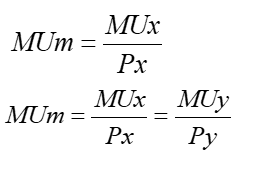
in equilibrium, an agent will allocate expenditures so that the ratio of marginal utility
to price (marginal cost of acquisition) is equal across all goods and services. it is also called Law of Equi-Marginal Utility


Cardinal Approach: Applications & Limitations
Applications
• Forms the base of the law of demand- why demand curve slopes downwards
• Law of Equi-Marginal Utility is derived
• Derivation of Consumer Surplus
• Progressive Taxation justification
• Water-Diamond paradox justification
Limitations
• Utility is not cardinally measurable
• Marginal Utility of money is not constant
• Utilities are not independent
• Fails to explain Giffen Paradox
• Can’t separate Income Effect and Substitution Effect
Ordinal Approach: Applications & Limitations
✓ Originally introduced by Pareto in 1906
✓ Satisfaction cannot be measured in absolute numbers, indeed can be ranked in order of preferences
✓ Indifference Curve Analysis (initially developed by Francis Ysidro Edgeworth in 1881). Later on, Pareto was the first one to actually draw these curves in 1906. Hicks and R.G.D. Allen published their comprehensive work based upon Edgeworth, Pareto & Slutsky in 1934
Axioms (True Statements)
• Axiom of reflexiveness: any combination is at least as good as itself, i.e., A(x1, y1) > A(x1, y1).
• Axion of completeness: He can compare two combinations of goods.
✓ A > B → Strictly preferred
✓ A ≥B → A is at least as preferred as B, or consumer weakly prefers A to B
✓ A ~ B → He is indifferent
✓ If A ≥ B and B ≥ A, then A ~ B
• Axiom of Transitivity: if A > B and B > C, then A > C
• Axiom of continuity of preferences: It means that there are no ‘jumps’ in one's preferences. In mathematical terms, if we prefer to point A along a preference curve to point B, points very close to A will also be preferred to B.
✓ Axion of Non-Satiation (MIB): the more the consumer gets of one or of both the goods, the higher would be his level of satisfaction.
✓ Axiom of Convexity: This ensures that two ICs would not intersect with each other
✓ Axion of Selfishness: Consumer is selfish and is self-guided and is not influenced by any other consumer
Properties of IC
• Higher IC gives higher utility
• ICs can’t intersect each other
• IC slope downward to the right (-ve slope)
• IC are convex to the origin (diminishing MRS)

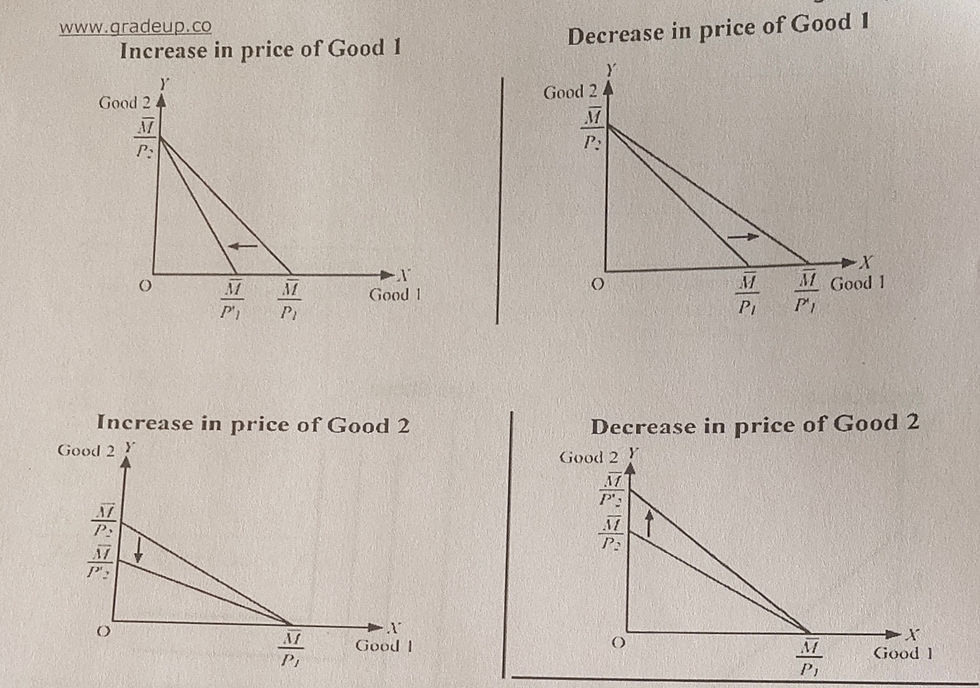
Ordinal Approach: IC Analysis [Specific Cases]



Veblen Effect, Snob Effect and Bandwagon Effect


The snob effect refers to the desire to possess a unique commodity having a prestige value. The snob effect works quite contrary to the bandwagon effect. The quantity demanded of a commodity having a snob value is greater, the smaller the number of people owning it.
The bandwagon effect refers to the desire or demand for a good by a person who wants to be in style because possession of a good is in fashion and therefore many others have it.

![Heckscher Ohlin Samuelson Model [1919, 1933, 1949] (Eli Heckscher & Bertil Ohlin)](https://static.wixstatic.com/media/23a551_18e17dbd1102480db63557c3cc0ee123~mv2.png/v1/fill/w_940,h_847,al_c,q_90,enc_avif,quality_auto/23a551_18e17dbd1102480db63557c3cc0ee123~mv2.png)
Comments